An external Transcend TS480GESD230C SSD that had suddenly stopped working was received for data recovery. The device uses an ASM235CM USB-to-SATA bridge together with a Silicon Motion SM2258XT SSD controller.
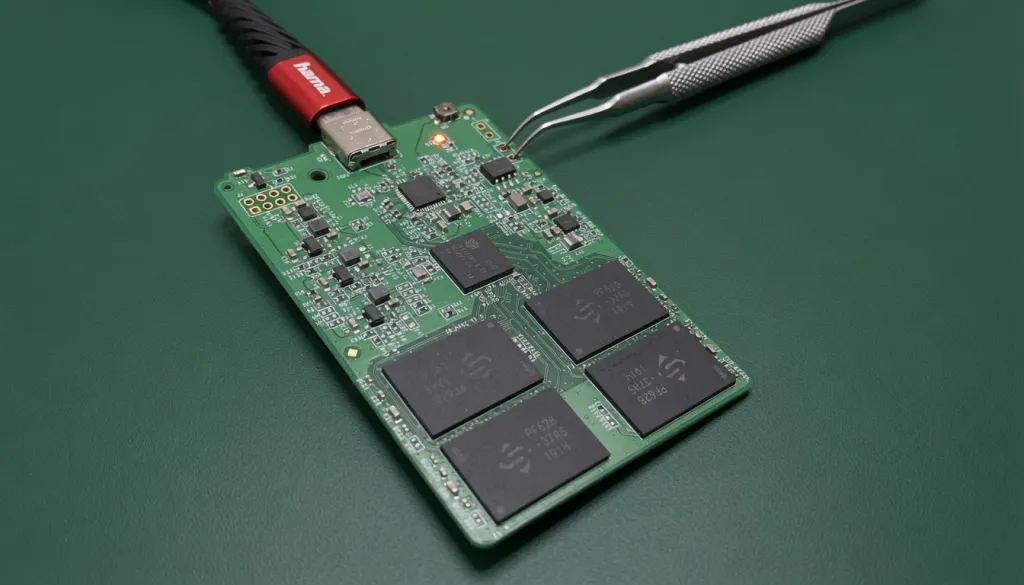
Until quite recently, in cases involving this type of USB SSD, the only practical option was to rebuild the drive by bypassing the USB bridge and providing direct access to the SATA interface. This approach was also used for this drive, but it was not sufficient. In this particular case, it was not possible to load and execute the appropriate microcode, which prevented us from proceeding to the next level of controller operation and obtaining functional access to the user data.
The situation changes with the new USB-level recovery method, which allows low-level access to the SSD directly through its USB interface, without physically rebuilding the device for SATA access. In this case, this approach, together with support for the controller configuration, made it possible to successfully recover the user's data.
This functionality is available in PC-3000 SSD, starting from version 3.9.8.
The currently supported USB SSD configurations include:
- Transcend ESD400 — ASM1153E (USB) + SM2246XT (SATA)
- Transcend ESD230C — ASM235CM (USB) + SM2258XT (SATA)
- Lenovo ThinkPlus TU200 — ASM235CM (USB) + SM2259XT (SATA)
- HP P700 — JMS583 (USB) + SM2263XT (NVMe)
- Smartbuy S3 — ASM1153E (USB) + PS3111 (SATA)
This development is particularly interesting because the architecture of USB SSDs is gradually changing. Devices are already appearing on the market in which USB functionality is no longer provided by a separate bridge chip, but is instead integrated directly into the SSD controller itself. This means that the traditional approach of bypassing the USB bridge and rebuilding the device for SATA access will not always be possible or necessary in the future.
As a result, USB-level recovery is becoming an increasingly important approach when working with modern external SSDs, especially in cases where traditional access through a SATA or NVMe interface is not possible.